Plastic Pipe Production Line for Municipal Water Supply: How Large Projects Drive Production Decisions
Municipal water projects can change the economics of pipe manufacturing long before the first order reaches the factory. A citywide network may require several diameters, substantial tonnage, strict delivery schedules and documented conformity, making production capacity a project-specific calculation rather than a simple equipment purchase. DEKUMA develops extrusion equipment for construction and infrastructure applications, while its pipe systems cover a broad range of diameters and materials.
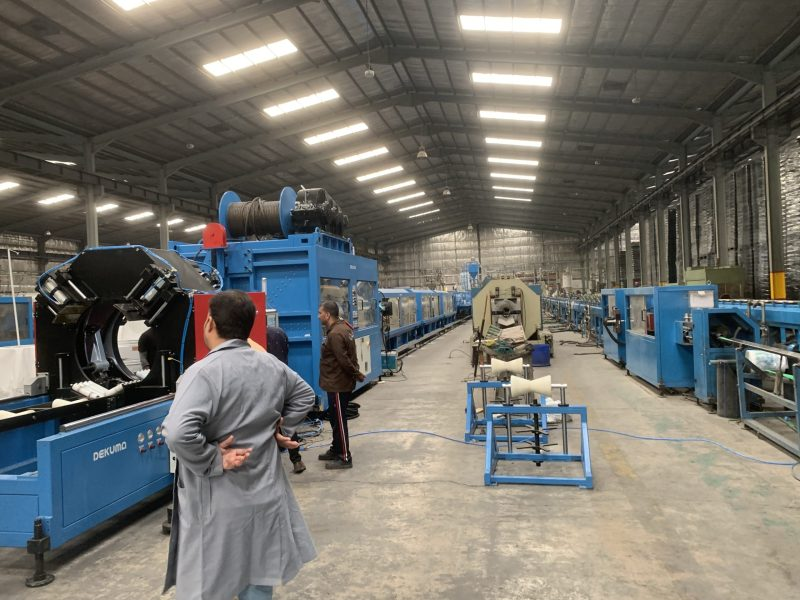
Translating Project Drawings Into Capacity
The pipe schedule is usually the starting point for equipment planning. Municipal water contracts can contain several nominal diameters, pressure classes and wall-thickness requirements, with demand concentrated differently across transmission mains, distribution networks and service connections. ISO 4427, for example, addresses PE piping systems for water supply as well as drainage and sewerage under pressure, including requirements covering PE compounds, pipes, fittings and system fitness for purpose.
Production planners need to convert those specifications into actual machine hours. A large-diameter pipe consumes considerably more material per metre than a small distribution pipe, while thick-wall grades can reduce achievable output compared with lighter products. Consequently, annual project tonnage alone does not reveal the required equipment size; the diameter mix, wall thickness, resin grade and expected operating hours must be considered together.
Scheduling creates another constraint. If a contract calls for several diameters within a relatively short delivery window, excessive changeovers can reduce productive hours and increase startup scrap. Capacity planning may consequently involve assigning high-volume sizes to one line while reserving another configuration for less frequent specifications, depending on the producer’s order profile.
Matching Equipment to Pipe Size
The broader construction-pipe platform is specified for pipe diameters from 6 to 2,000 mm, allowing equipment planning to extend from relatively small infrastructure pipes toward much larger applications. The important consideration is not simply the maximum diameter stated in a specification sheet; die design, calibration, cooling capacity, haul-off configuration and available floor space all have to correspond with the intended pipe family.
An extrusion pipe machine selected for municipal work should also be assessed through its changeover logic. Tooling that can be exchanged efficiently, accessible calibration equipment and repeatable process recipes can influence the real production rate just as much as nominal extruder output. For a factory serving multiple contract specifications, flexibility may have greater operational value than simply selecting the largest available configuration.
Building Quality Into Contract Delivery
Municipal procurement commonly places greater emphasis on documented conformity than ordinary commercial pipe orders. ISO 4427:2019 covers PE systems used for water supply and pressure applications, while the series separates requirements across general aspects, pipes, fittings and fitness for purpose. Local authorities may additionally reference national standards, project specifications, potable-water requirements or third-party certification schemes.
Quality planning should begin with measurable characteristics. Outside diameter, wall thickness, ovality, material identification and pressure-related properties can form part of the inspection framework, depending on the applicable standard and contract. Recording these results by production batch gives engineering teams a way to connect finished-pipe performance with material lots, tooling and process conditions.
Certification is also more useful when it is connected to factory procedures rather than treated as a purchasing document. Auditors and project owners may examine calibration records, inspection methods, traceability systems and corrective-action records. A producer preparing for a major municipal contract can benefit from mapping those requirements before production begins, since missing documentation may create administrative problems even when physical pipe quality is satisfactory.
Structuring Capacity Around Long-Term Demand
Large contracts can create a temporary surge that does not necessarily justify permanent overcapacity. Investment decisions should distinguish between confirmed project volume, probable follow-on orders and the manufacturer’s existing customer base. Utilization forecasts can then compare additional line capacity with available production hours, maintenance windows and expected changeover losses.
A flexible plastic pipe production line can also support market diversification after the municipal project ends. The same extrusion platform may serve water, drainage, gas or other infrastructure applications when the material, tooling and downstream configuration are appropriate. DEKUMA states that its construction extrusion solutions cover PE, PVC and other pipe applications, with single-screw and twin-screw configurations available for different materials.
Supplier evaluation should include what happens after commissioning. A Middle Eastern pipe producer that had previously used equipment from a German manufacturer reportedly inspected DEKUMA’s facilities in 2013 before beginning a long-term partnership. Such a reference is useful not as proof that every project requires the same configuration, but as an example of how an on-site technical assessment can form part of equipment selection.
Conclusion
Municipal water contracts turn pipe manufacturing into a coordination exercise involving diameter distribution, material consumption, production scheduling, conformity documentation and future utilization. Equipment capacity should be derived from the actual project mix rather than from headline output figures alone, while tooling and quality systems need to support the specifications written into the contract.
DEKUMA provides extrusion platforms spanning different screw sizes and construction-pipe applications, giving producers a basis for matching equipment architecture with project requirements. Ultimately, an extrusion pipe machine becomes part of a larger delivery strategy: its value depends on how effectively the factory can turn specified materials and dimensions into documented, repeatable production across the contract period.